Author
Luana Pereira
Date
August 31, 2026
Category
AI agents
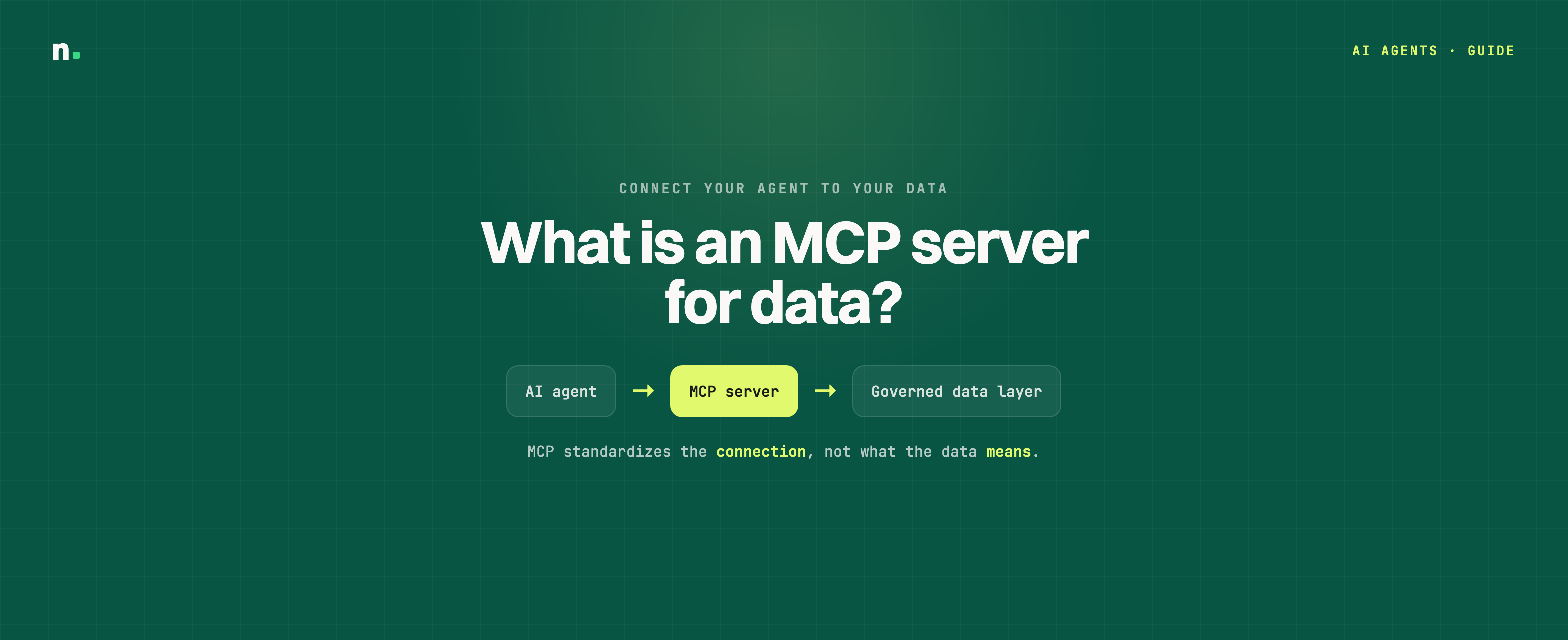
An MCP server for data exposes your data to an AI agent through the Model Context Protocol, the open standard for how agents discover and call tools, so the agent can query in plain language instead of through a bespoke integration. You need one when an agent has to reach company data reliably, with permissions and meaning attached. But MCP standardizes the connection, not what the data means, so what sits behind the server decides whether the answers can be trusted.
An MCP server for data is a server that exposes your data to an AI agent through the Model Context Protocol (MCP), the open standard for how an agent discovers and calls a tool. Instead of a hand-built integration for every model, the agent connects to the server, sees the tools it offers (for example, run a query, list tables, read a record), and calls them in plain language. MCP was introduced by Anthropic in late 2024 as an open protocol and became a de facto standard through 2025, which is why "connect your agent over MCP" is now a default expectation rather than a custom project.
The important part is what the server sits on top of. A protocol standardizes how an agent reaches a system. It does not standardize what the system's data means. So an MCP server pointed at raw tables lets an agent reach everything and understand nothing, which usually makes it guess faster. An MCP server pointed at a governed data layer lets the agent read meaning, not just rows. Same protocol, very different result.
MCP solves connection, not meaning. What decides whether an agent's answers can be trusted is the data layer behind the server, not the protocol in front of it.
It solves integration, and it solves it well. Before MCP, every agent-to-system connection was bespoke: a custom adapter, a custom auth flow, a custom schema. After MCP, connection is a protocol, so an agent can discover and call tools the same way everywhere. That is a real advance, and it is why MCP spread so fast.
What it does not solve is business meaning. The server can hand an agent the raw value of a field. It cannot tell the agent that the field is stored in millionths, that a deal marked "won" two years ago is not revenue today, or that two records with different names are the same company. That knowledge is context, and context does not travel in the protocol; someone has to model it into the data. This is the same gap covered in depth in Context Engineering for AI agents: the protocol connects, the semantic layer gives meaning, and you need both.
You need one when an AI agent has to reach your company data reliably, repeatedly, and with permissions, rather than through one-off copy-paste. The clear signals:
You do not need one when the task is a single document the agent can read directly, or a one-time question you can answer by hand. MCP earns its place when access is ongoing and has to be governed.
These are three different ways to give an agent data, with different trade-offs. The short version: a direct database connection is the most raw, an API is the most rigid, and an MCP server is the one built for agents to discover and call tools, provided there is a governed layer beneath it.
| Approach | How the agent uses it | Best for | The catch |
|---|---|---|---|
| Direct database access | Runs raw queries against tables | A single, well-known database | No meaning, no per-agent scope; the agent reads raw rows and guesses the rules |
| API | Calls fixed, pre-defined endpoints | Known, repeatable operations | Rigid; every new question can need a new endpoint |
| MCP server | Discovers and calls tools over a standard protocol, in plain language | Agents that query company data across systems, ongoing | Only as good as the data layer behind it; on raw data it just guesses faster |
Not the protocol, which is the same everywhere, but the layer it serves from. A good MCP server for data hands the agent modeled data with its meaning attached, and it enforces who can see what. Concretely:
Nekt is a data platform that gives AI agents governed context, and its MCP server is the last mile of that. It follows the same three parts an agent needs:
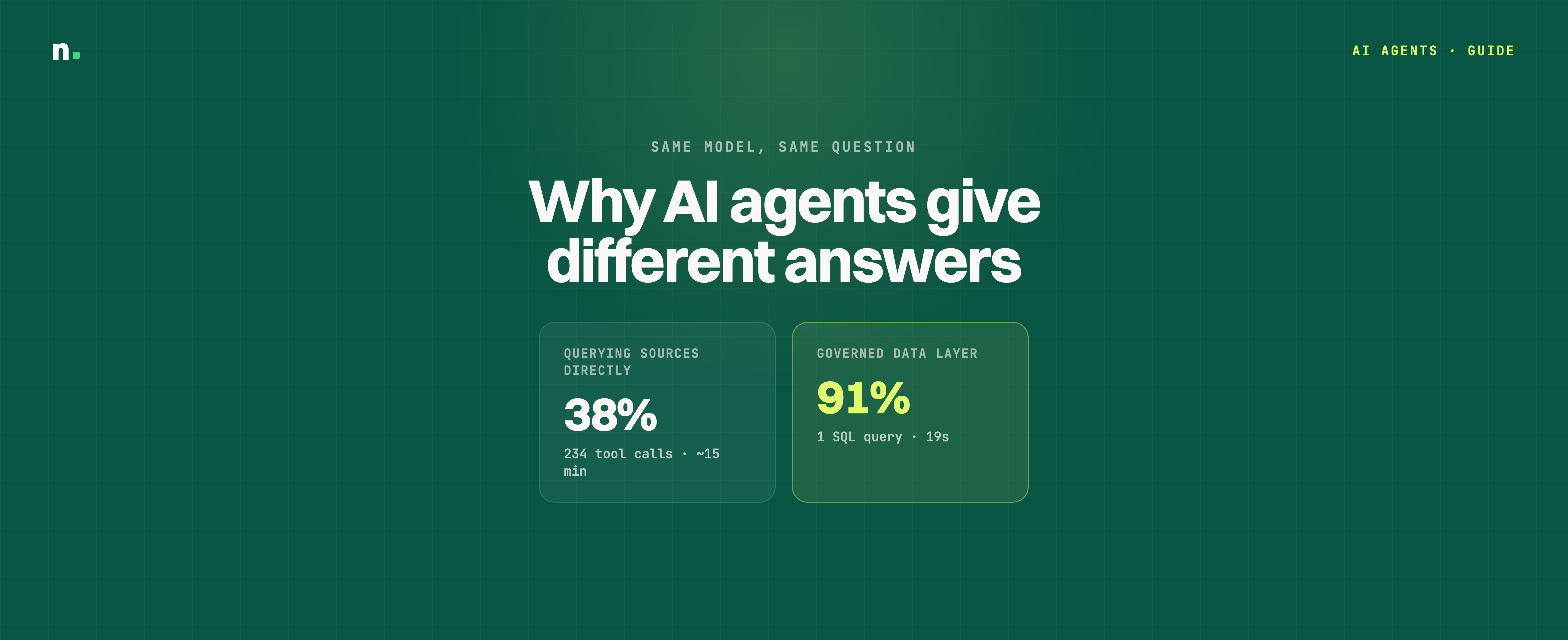
The difference shows up as accuracy, cost, and speed on the same model. In one production benchmark, an agent querying sources directly answered correctly 38% of the time, across 234 tool calls, in about 15 minutes. The same agent on Nekt's governed layer, with context served over MCP, reached 91% accuracy with a single SQL query in 19 seconds. (Nekt benchmark.)
Same model, same question: 234 tool calls at 38% accuracy, or one query at 91%. An MCP server on raw data multiplies the tool calls; an MCP server on a governed layer collapses them into one.
See how Nekt works, or create a free account and connect your first source.
No. An API exposes fixed, pre-defined endpoints. An MCP server exposes tools an agent can discover and call over a standard protocol, in plain language, so you do not need a new endpoint for every new question. An MCP server can sit in front of APIs, databases, or a governed data layer.
Not strictly, but you need something governed behind it. An MCP server on raw sources lets an agent reach data without understanding it. A modeled layer (Raw, Trusted, Service) is what turns MCP access into trustworthy answers.
Security depends on the server, not the protocol. A good MCP server for data enforces per-agent, per-table permissions at the data layer, with minimum scope, so access is a control rather than a line in a prompt.
Yes, if the data from those systems is brought together and modeled first. That is exactly where the value is: an agent asks one question and crosses many sources in a single query, instead of paging through each system separately.
No. RAG is a retrieval technique for pulling relevant records into the context window. An MCP server is a connection layer that lets an agent call tools. You can use RAG behind an MCP server, but neither one supplies the business rules that make the retrieved data mean something.