Author
Luana Pereira
Date
October 8, 2026
Category
AI agents
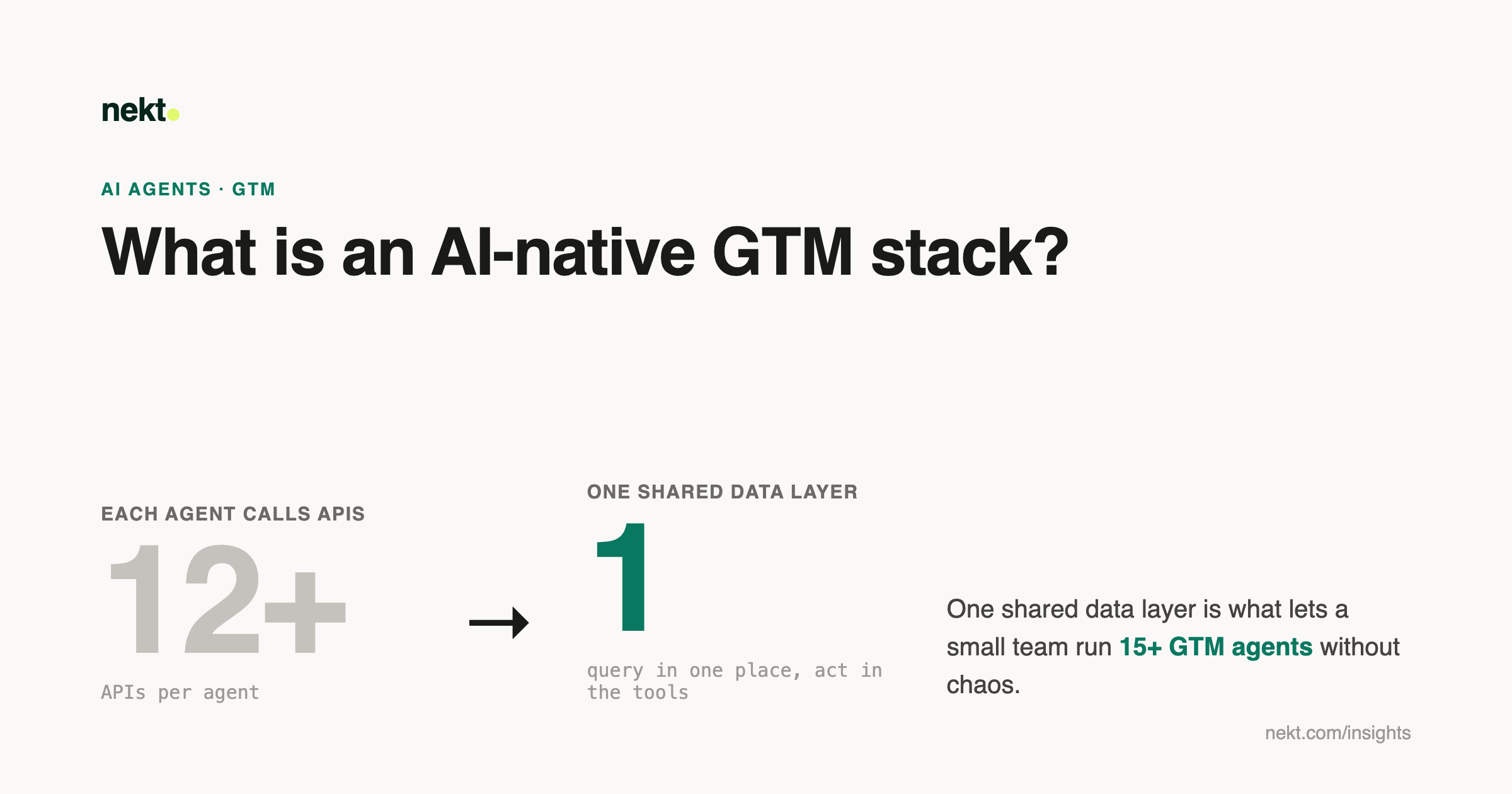
An AI-native GTM stack is a go-to-market operation built on a single data layer that works as shared memory for every agent, rather than a pile of disconnected AI features. The agents query that layer in one place, over SQL or an MCP server, and execute in the source tools, and that separation is what lets a small team run many GTM agents without the system collapsing into chaos. This guide covers why the central layer matters, the query-in-one-place pattern, how an agent writes in a person's voice, and the order to build it in.
An AI-native GTM stack is a go-to-market operation built on a single data layer that works as shared memory for every agent, not a pile of disconnected AI features. The agents query that layer in one place, over SQL or an MCP server, and they execute in the source tools. That one separation, query in the layer and act in the tool, is what lets a small team run many agents without the system collapsing into chaos. AI-native does not mean more AI; it means the data underneath is unified enough that each agent reads one version of reality before it acts.
Over 30 days, a single GTM function at Nekt, run by one operator, held 829 active conversations and roughly 3,000 messages through one data layer with zero duplication errors, at a 22% reply rate against a 5-8% market benchmark.
The distinction matters because the common assumption runs backwards. Teams reach for another model or another automation when the missing piece is the layer that gives every agent the same context. With it, one person can operate a GTM function that would otherwise need a department. Without it, the second agent already contradicts the first. The number above is one operator's go-to-market function, not an entire company, and that is the point: the leverage comes from the layer, not from headcount.
Because without the layer, every agent has to join the sources by hand, which is slow, duplicates records, blows the context window, and burns tokens. With the layer, the agent asks one question in one place and gets a clean, finished answer. If a company does not have this layer, every agent it builds has to know a dozen different APIs, and each ends up with its own version of the customer, which is miserable to maintain and quietly wrong.
There is a cost dimension that is easy to miss. The number of tokens an agent spends paging through a tool's API to reconstruct an answer is far higher than a deterministic query against a governed layer, where the join is already done. Reading many systems inside the context window is exactly where accuracy drops and the bill climbs, the pattern described in why AI agents give different answers on the same data. The layer that removes that work is a semantic layer for AI agents: data modeled into business meaning so the agent reads a definition instead of rebuilding one.
The rule that holds the whole system together is a clean split between reading and doing. When an agent needs to know something about a customer, a signup, a deal, a conversation, it queries the layer, in SQL, in seconds. When it needs to do something, create a calendar event, send a message, update a deal, post to a channel, it calls that tool directly. Each tool stays the source of truth for what it does, and the layer is what joins everything to give the agent context.
| Step | Where it happens | Why |
|---|---|---|
| Query | The data layer, over SQL or MCP | One joined answer, no rate limits, no divergent copies |
| Act | The source tool's own API | Each tool stays the source of truth for what it owns |
The layer also keeps history, every change to every record over time, every stage transition with a timestamp. That turns attribution into a parameter rather than a project: position-based, linear, last-touch, whichever the question needs, computed from the same stored history instead of a separate customer-data platform. Running paid ads through this same split, querying performance in the layer and acting in the ad platforms, is covered in how to run paid ads with an AI agent.
With a voice profile: a structured file that captures how a specific person writes, rebuilt automatically from their own best posts. A weekly job scores past posts and splits them into buckets by percentile, keeping the top 25% as the model of what works. The score is deliberate and simple:
score = reactions x 1 + comments x 10 + reposts x 2. A comment is weighted ten times a reaction because it is real work and the true signal of reach; a repost counts double because it amplifies without the friction of writing.
From there the agent analyzes the top and bottom buckets for linguistic patterns, failure patterns, and rules per content category, and writes the result to a structured profile the writing agent reads before drafting. In one such profile, 134 posts were analyzed to build the model. The division of labor is the important part: the deterministic side measures, ranks and categorizes; the model only writes. It does not replace writing; it removes the worst part, the blank page. Keeping the calculation deterministic and the language generative is the same boundary as in measuring social engagement before you have volume and the broader practice of context engineering for AI agents.
The numbers below come from one GTM function at Nekt, operated by a single person with more than 15 agents, over a 30-day window. They describe outbound on one channel, and they are first-party figures for that function, not a company-wide claim.
| Metric | Value | Context |
|---|---|---|
| Reply rate | 22% | Against a 5-8% market benchmark |
| Connection rate | 68% | Affinity before the message, not a cold list |
| Active conversations | 829 in 30 days | Across three senders |
| Messages in one layer | ~3,000, zero duplication | Synced across senders with no double-count |
The reply rate is not the interesting part on its own; the zero-duplication across three senders is. It is the proof that the agents shared one version of reality. Three people sending, one layer reading, and no message counted twice, which is exactly what falls apart when each agent keeps its own copy.
From simplest to most dependent, so each stage stands on the one before it. The order is unified data, then query, then action, then memory, and skipping ahead is where most attempts stall.
The last stage is the one teams jump to first, and it is the one that fails without the foundation. Respecting the order is the difference between a system that compounds and a pile of scripts that fight each other.
Nekt is a data platform that gives AI agents governed context, which is the central layer an AI-native GTM stack is built on, acting as the memory every agent shares.
The payoff is a small team operating like a large one, because the hard part is carried once in the layer instead of re-solved in every agent. See how Nekt works, or create a free account and connect your first source.
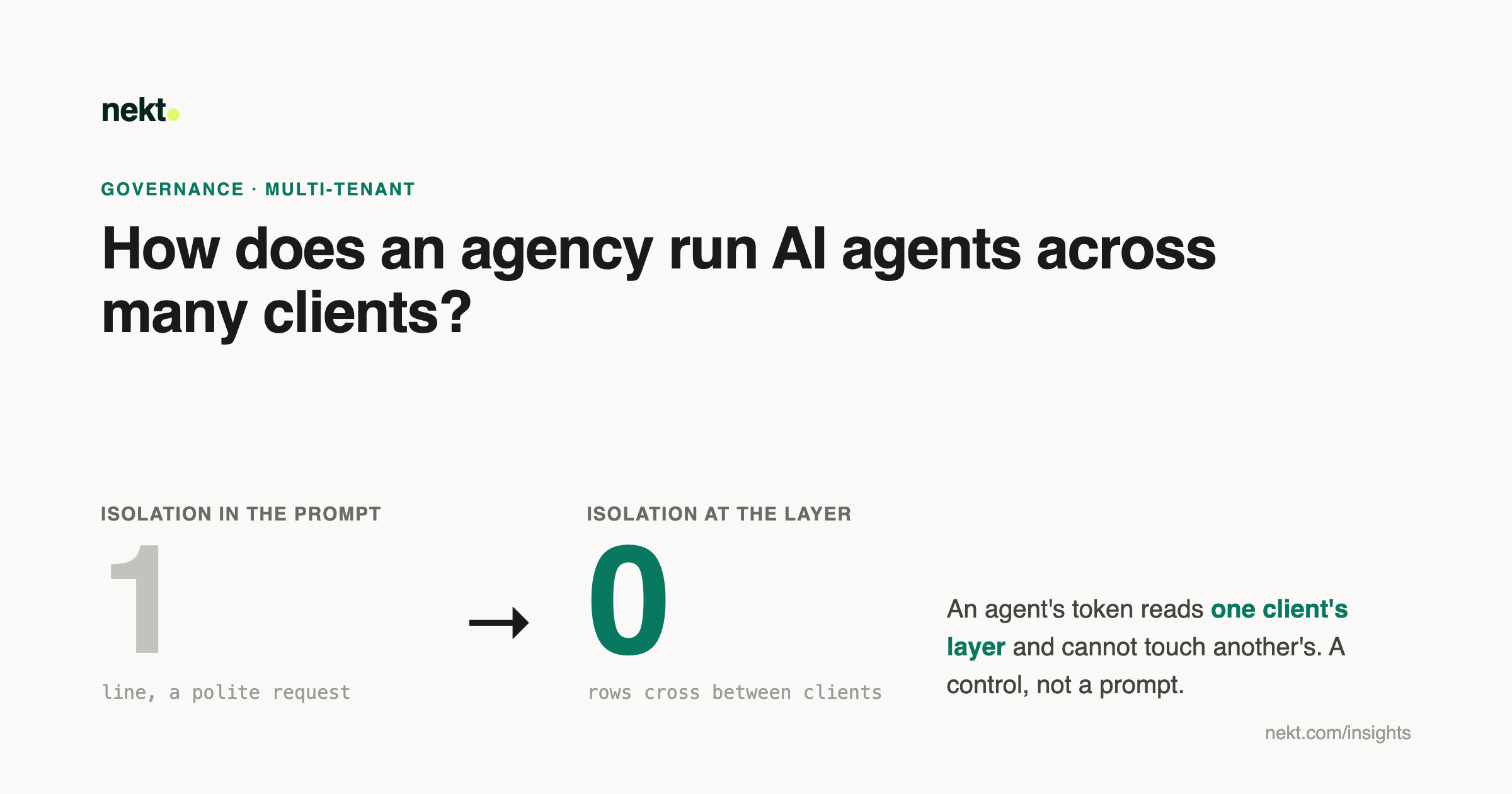
Yes, if the agents share one data layer. The constraint is not how many agents you can write; it is whether they read the same version of reality. With a central layer each agent queries one place and acts in the tools, so a single operator can run more than fifteen without them contradicting each other. Without it, coordination cost grows faster than the agents help. The same architecture extends to an agency running agents across many clients, each client isolated, covered in how an agency runs AI agents across multiple clients.
Because it does not scale and it drifts. Each agent would have to know many APIs, hit rate limits in volume, spend far more tokens reconstructing answers, and end up with its own copy of the customer. Querying a governed layer once is cheaper, faster, and consistent; acting in the tool afterward keeps that tool as the source of truth.
AI-assisted means AI features bolted onto existing tools, each tool still a silo. AI-native means the data layer is the foundation and the agents are built on top of it, querying one shared memory and acting in the tools. The difference is architectural: assisted adds AI to the edges, native puts a unified data layer at the center.