Author
Luana Pereira
Date
October 7, 2026
Category
AI agents
A semantic layer for AI agents is a governed layer of data modeled into business meaning, metrics, entities, and rules, that an agent reads instead of raw tables. It is what lets an agent answer a question the same way a trusted analyst would, because the definition of an active customer or of revenue lives in the data, not in a prompt. Without it, an agent reaches everything and understands nothing, so it guesses.
A semantic layer is data modeled into business meaning, the metrics, entities and rules of the business, sitting between raw sources and the agent, so the agent reads a definition instead of guessing one. It answers questions like what an active customer is, which date counts as revenue, and whether two records are the same company, before any model is asked. For an AI agent this is the difference between reaching data and understanding it: with a semantic layer the agent reads the rule, without it the agent invents one and states it with confidence.
A semantic layer is where the business logic lives once, so every agent and every report answers the same question the same way. Without it, the same question returns a different number each run.
The idea is not new. Business intelligence tools have had semantic layers for decades, a place to define a metric once so dashboards agree. What changed is the consumer. A dashboard shows a human a number to interpret; an agent takes the number and acts. So the layer is no longer a convenience for consistent charts, it is the control that decides whether an autonomous agent is trustworthy.
Because an agent does not ask when it is unsure, it deduces, and it deduces with confidence. A person who opens a table with a strange column name asks a colleague. An agent fills the gap with a plausible assumption, writes a convincing paragraph around it, and moves on. The semantic layer removes the guess by putting the meaning next to the data. The gap it closes is not knowledge the model lacks in general, it is knowledge specific to one company: that a cost is stored in millionths, that a deal marked won two years ago is not revenue today, that the field with an odd name holds the lead source.
This is also where the analyst industry now draws the line. Gartner projects that "by 2027, organizations that prioritize semantics in AI-ready data will increase agentic AI accuracy by up to 80% and reduce costs by up to 60%" (Gartner, Gartner Says Lack of Semantics Causes Inaccurate AI Agents and Wasted Spending, May 11, 2026). The same research warns that projects relying on connection alone will fail for lack of a consistent semantic layer. Accuracy and cost both move with semantics, not with the model.
It contains the definitions an agent would otherwise have to invent: metrics, entities, relationships, and the rules that bind them. Concretely, four things:
The first three are classic data modeling. The fourth, context engineering, is the part most teams skip, and it is exactly what an agent needs, because an agent cannot ask what a column means.
The cleanest way to build one is in three stages, each with a single job, so meaning accumulates instead of being redone per query.
The effect is that intelligence leaves the prompt and moves into the data model. The agent stops being the place where the business rule lives and goes back to what it is good at: understanding a question in plain language and choosing the right table.
They solve different problems, and an agent usually needs more than one. A warehouse stores the data, RAG retrieves text into the context window, and the semantic layer supplies the meaning. The short version: a warehouse without a semantic layer still makes an agent guess, and RAG without one retrieves clean-looking data with no rules attached.
| Layer | What it does | What it does not do |
|---|---|---|
| Data warehouse | Stores and queries data at scale | Does not define what the data means |
| RAG | Retrieves relevant records into the context window | Does not carry the business rules for what it retrieves |
| Semantic layer | Defines metrics, entities and rules once, served with the data | Does not replace storage or retrieval; it sits on top of them |
MCP belongs in the same picture as connection, not meaning: it standardizes how an agent reaches the layer, covered in what an MCP server for data is. Connection, storage, retrieval and meaning are four jobs, and the semantic layer owns the last one.
It reaches everything and understands nothing, so it guesses faster. The failures are consistent, and none of them appear in the demo; they appear in month three.
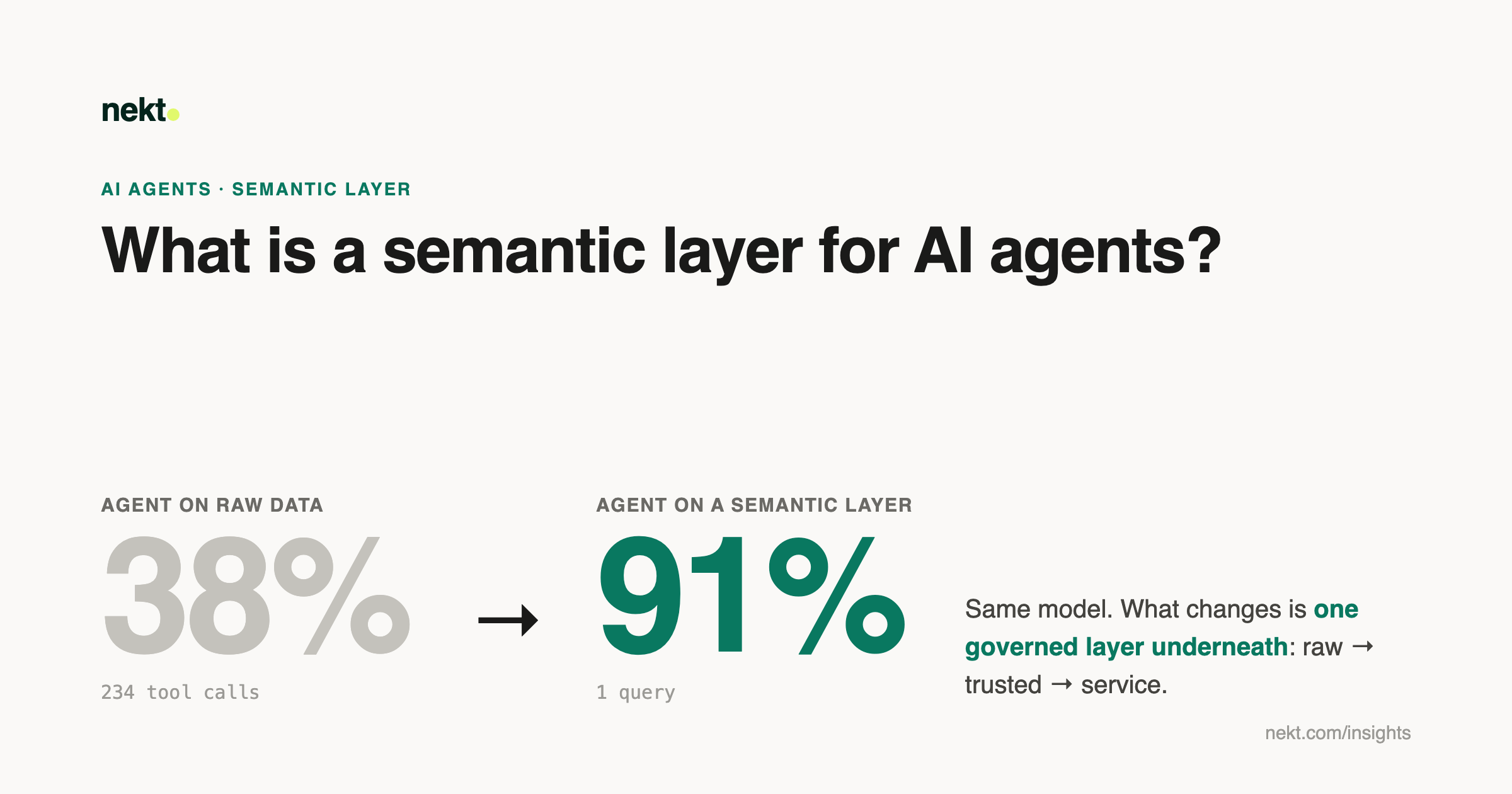
This is why the same model can answer the same question at 38% accuracy over 234 tool calls, or at 91% accuracy in a single query, depending only on whether a governed layer sits underneath it. The pattern is the subject of why AI agents give different answers on the same data.
Nekt is a data platform that gives AI agents governed context, which is a semantic layer delivered as a product rather than a project. It covers the three parts an agent needs in one place.
The point is that the rule is written once and reaches every agent, instead of being re-explained in each prompt. That is what moves a benchmark from 234 tool calls at 38% accuracy to a single query at 91%. See how Nekt works, or create a free account and connect your first source.
A metrics layer is part of a semantic layer, not the whole thing. A metrics layer defines measures like revenue or MRR once. A semantic layer includes those metrics plus entities, relationships and per-column context, everything an agent needs to interpret the data, not only the headline numbers.
Yes. A warehouse stores and queries data, but it does not define what the data means. An agent pointed at warehouse tables with no semantic layer still has to infer definitions, which is where it starts to guess. The semantic layer sits on top of the warehouse and supplies the meaning.
They overlap heavily for data agents, but they are not identical. The semantic layer is the governed data and its definitions. Context engineering is the broader practice of assembling everything an agent sees, which for data agents is largely the semantic layer, plus memory, tools and how the window is filled at runtime.
A small team can build one, especially on a platform that handles the heavy lifting. The modeling work, deciding the ten questions, the keys and the rules, is a data and business exercise more than a coding one. The engineering of connectors, orchestration and serving is what a platform removes.